Tool Guide
Triple Whale
“First-party attribution for DTC brands serious about multi-channel ROAS.”
We earn a commission from purchases via this link.
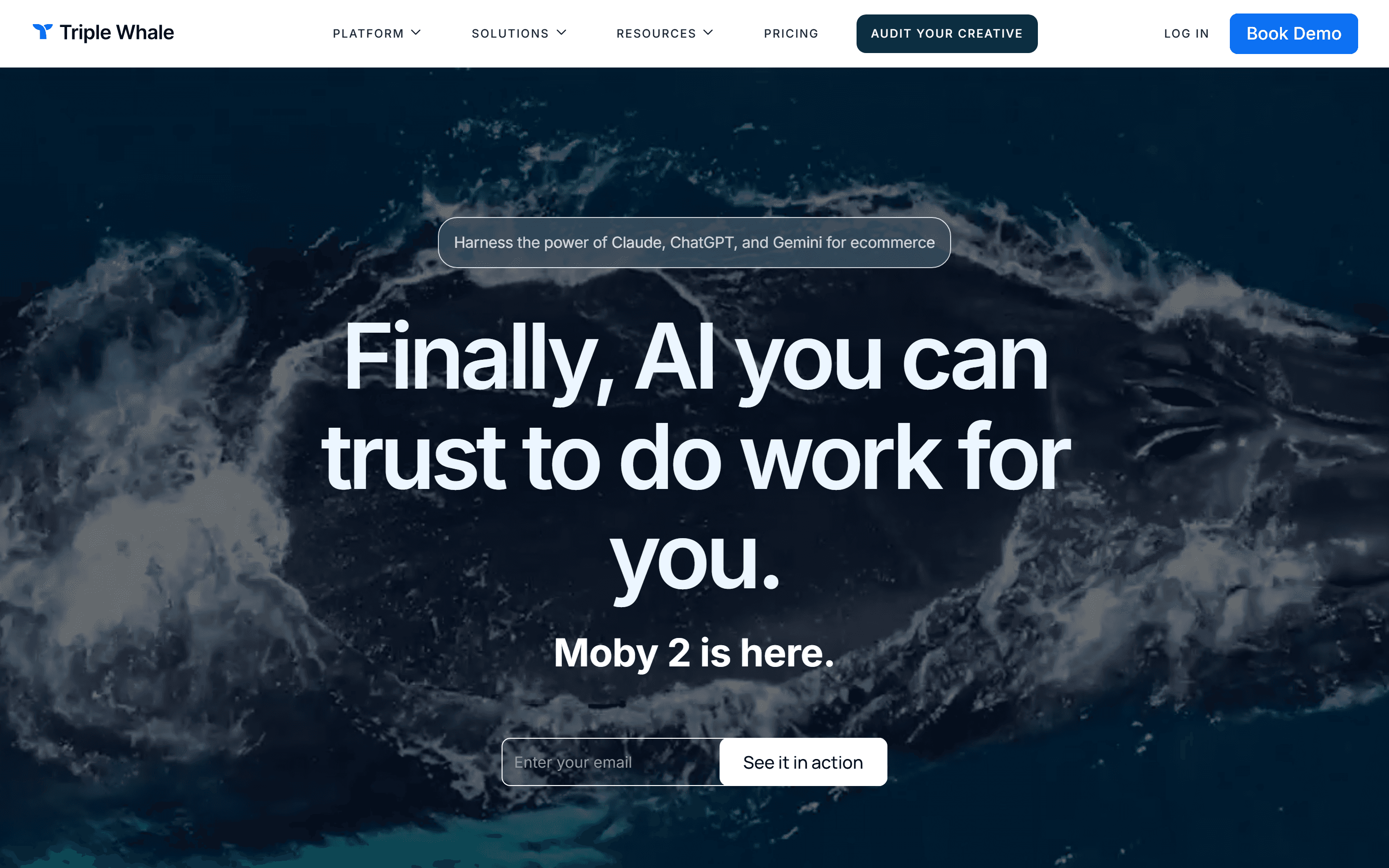
Triple Whale is the attribution layer that most multi-channel Shopify DTC operators end up paying for once iOS 14 broke in-platform attribution. The 2026 product positions around Moby 2, an AI assistant that sits on top of the first-party pixel data and tries to take some attribution-analysis work off the operator's plate. The underlying value still concentrates in the pixel and the blended dashboards — Moby is the new layer, but the reason stores buy Triple Whale is still "I cannot trust Meta's reported ROAS, and I have ad spend on three platforms".
What Triple Whale actually does
The product owns first-party pixel data from the store's checkout and post-purchase pages, then blends it with reported numbers from Meta, TikTok, Google, and Klaviyo to give operators a single view of channel mix, creative-level ROAS, and contribution margin. Moby 2 layers AI on top of that data — operators can ask "which creatives drove the most contribution margin last week" instead of building dashboards.
Main features
First-party pixel
The Triple Whale pixel sits on the storefront and the post-purchase page. The attribution data is the store's, not the ad platform's. This is the foundation of everything else — the dashboards, the blended view, Moby's answers all start from this data. Pixel installation has to be clean: get it wrong and the numbers lie consistently.
Blended dashboards
Orders, refunds, product data, ad-platform spend, and email-attributed revenue all sync into one set of dashboards. The default views — channel mix, creative-level ROAS, intraday hourly — answer the questions most multi-channel operators check daily without custom work. Custom dashboards are a one-afternoon build for an operator who can name the metric they want.
Moby 2 (the 2026 AI layer)
Moby is Triple Whale's AI assistant — operators ask questions in natural language ("which Meta creatives had the highest contribution margin last week, and how did they compare to last month") and Moby returns a tabled answer with explanations. The accuracy depends on the underlying pixel quality and the specificity of the question; broad questions return shallow answers, specific questions return useful ones. As a roadmap signal Moby is genuinely interesting; as a daily replacement for dashboard-building it is closer than competitors but not yet at full autonomy.
Sonar
Sonar (on Pro and above) sends Triple Whale's clean conversion data back to ad platforms as conversion events. This pushes the ad-platform optimization algorithms toward the conversions that Triple Whale's pixel sees as real, rather than the ones Meta or Google's reduced post-iOS-14 signal sees. For stores already running well-tuned campaigns, Sonar is where the marginal lift shows up.
Who Triple Whale fits
Triple Whale fits DTC stores running multi-channel paid acquisition (Meta + TikTok + Google + sometimes Snap or Reddit) with at least $50K/month in ad spend. The first-party pixel and blended attribution dashboards concentrate the value at that scale.
It does not fit stores running a single channel or under $10K/month in ad spend — the seat cost dominates the value at that scale, and Meta's own attribution is often acceptable for a single-channel account. It also does not fit operators whose real problem is creative production rather than attribution clarity — Triple Whale will not generate more creative.
Pricing logic
Growth at $129/mo covers the pixel and standard dashboards — the right tier for stores under roughly $500K/year in ad spend running multi-channel. Pro at $399/mo adds Sonar and deeper custom-metric tools. Enterprise is custom pricing for stores past $10M/year in revenue. Annual billing knocks roughly 17% off. Onboarding support is included on Pro and above. The pricing is gated through sales — public price visibility is partial — so the demo conversation is part of the buy-in.
Alternatives
The two products that come up against Triple Whale in evaluations are Northbeam and in-platform attribution.
Northbeam is the closest direct competitor — first-party pixel, multi-channel attribution, and an AI assistant of its own. The pricing is similar at comparable scale; the choice often comes down to which tool's dashboard model fits the operator's mental model better, plus the quality of onboarding support each team provides.
In-platform attribution — sticking with what Meta, TikTok, and Google report directly — is the cheap-end alternative. For single-channel accounts it can be enough. For multi-channel accounts the post-iOS-14 reported numbers tend to double-count conversions across platforms, which is the problem first-party attribution exists to fix.
Choosing between them is mostly a scale question. Below $50K/month in ad spend and one channel, in-platform attribution plus a spreadsheet is enough. Above $50K/month and three channels, the first-party pixel pays back through better spend allocation decisions.
Where to start
Growth at $129/mo is the right entry point for a multi-channel Shopify store under $500K/year in ad spend. Book the demo first — pricing visibility is partial through public pages, and the sales conversation surfaces specifics that matter for fit. Step to Pro only when an operator has used Growth for at least two months and can name a specific Sonar use case; Pro before that is buying features ahead of need.
Pixel Audit note
If Triple Whale numbers look off compared to in-platform reports, the cause is almost always a pixel installation issue rather than a Triple Whale bug. The Solvir Pixel Audit tool flags duplicate pixel fires, missing post-purchase events, and mismatched currency settings before they corrupt attribution.
What it costs
Pricing
| Plan | Price | Features |
|---|---|---|
| Growth | $129/mo |
|
| Pro | $399/mo |
|
Prices verified on 2026-05-24. Subject to change — see the vendor's official page.
We earn a commission from purchases via this link.
Frequently asked
Does Triple Whale solve iOS 14 attribution loss?+
It significantly improves it via first-party pixel data, but no tool fully recovers the lost signal. Operators should expect 60-80% of pre-iOS-14 fidelity, not 100%.
Do single-channel stores need Triple Whale?+
For a single-channel account on Meta only, the in-platform attribution is often enough. Triple Whale earns its keep when ad spend blends across Meta + TikTok + Google + organic.
How long does setup take?+
A clean Shopify store with Meta/TikTok/Google ads connected installs and validates the pixel in under 2 hours. Custom pixel events and Sonar tuning take another day or two.
How to start
Growth at $129 covers pixel + dashboards for stores under roughly $500K/month. Book a demo before stepping to Pro — Sonar AI's pricing-fit conversation is part of the sell.
We earn a commission from purchases via this link.
How we make money
Solvir Tools is an independent, ad-supported guide site. We earn commissions when readers click certain links and complete a purchase on the vendor's site. Affiliate relationships never influence which tools we cover, how we describe them, or what we say about them. Every guide reflects our honest opinion based on hands-on testing, editorial research, or AI-assisted research with human fact-checking. We disclose every commission-eligible link clearly near the call-to-action. For full details on our editorial process, see our methodology and editorial policy pages.
You might also like