Tool Guide
Klaviyo
“The Shopify-default DTC CRM — segmentation depth at a bill that climbs with your list.”
We earn a commission from purchases via this link.
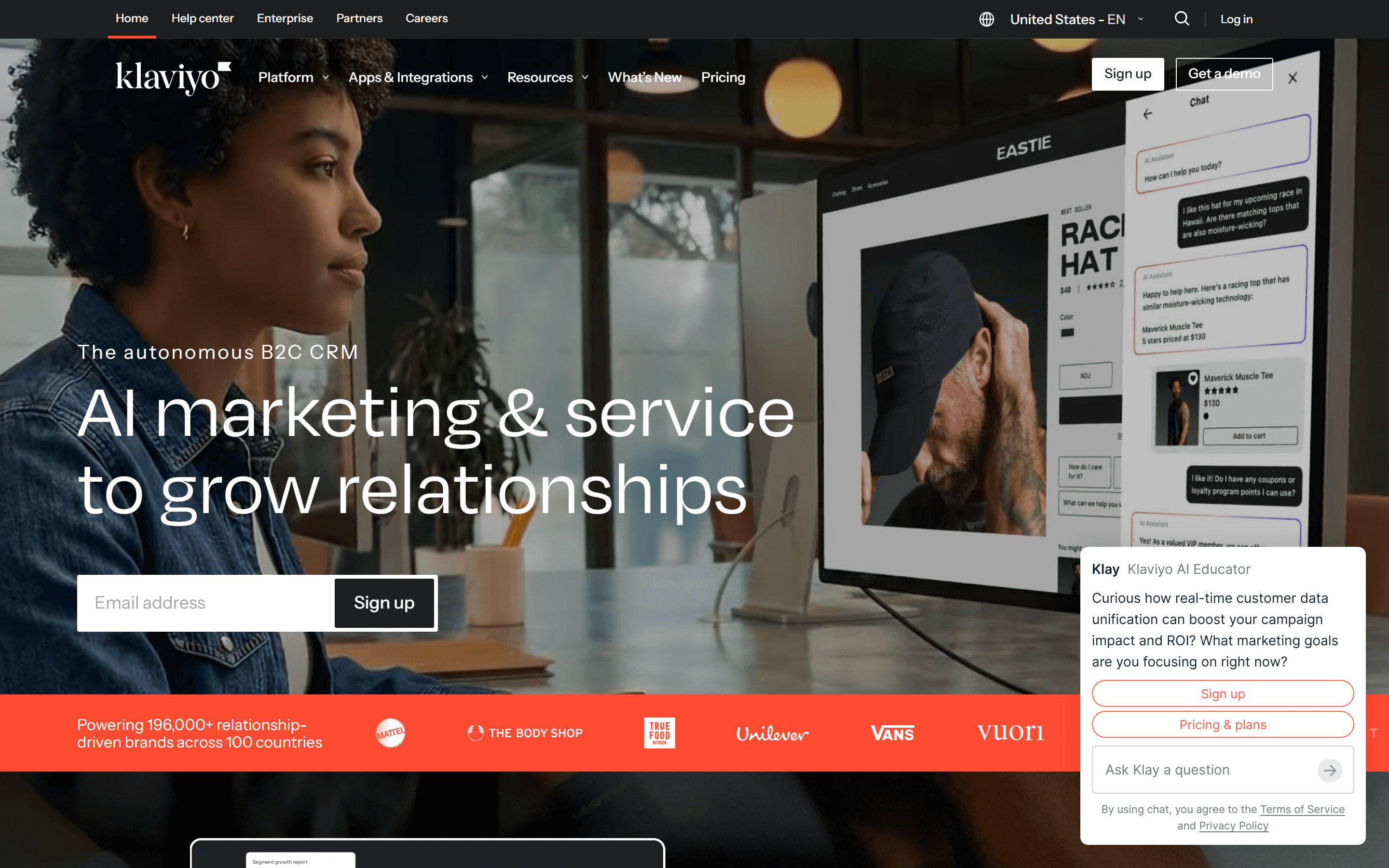
Klaviyo is the email-and-SMS platform Shopify itself recommends, and most DTC operators who can afford it end up there. The 2026 product positions as "the autonomous B2C CRM" — AI agents for campaigns and customer service, on top of the email-flow engine most operators originally bought it for. The surface area is bigger than the 2023 product, and the billing model changed in February 2025 in a way that quietly raises costs for stores that do not clean their list.
What Klaviyo actually does
Klaviyo is two products. The original one is a deep-Shopify-integrated email-and-SMS platform with a segmentation engine that no DTC-focused competitor matches at the same scope. The newer one is an autonomous CRM layer with AI agents that try to take some campaign and service work off the operator's plate. Most stores still buy Klaviyo for the original product and adopt the AI surface gradually as it matures.
Main features
Channels and Shopify integration
Email, SMS, WhatsApp, mobile push, RCS for Business, and (since the 2025 Gatsby acquisition) creator and social marketing. The Shopify integration is the differentiator — native, deeper than any competitor, with order, browse, and product data syncing cleanly within minutes of install. Most operators can segment on viewed-product, abandoned-cart, and lifetime-value the same hour they connect the app.
Segmentation engine
The segmentation builder is where Klaviyo's stickiness lives. Once an operator understands the property model — events, profile attributes, predictive metrics — the segments that get built actually differentiate winners from losers in the audience. A "viewed product in the last 14 days, has not purchased, lifetime spend over $100" segment is a five-minute build; equivalent work on a less DTC-focused platform is a half-day of pivoting and exporting.
Prebuilt flows and AI Composer
Welcome series, abandoned cart, post-purchase, browse abandon, and price-drop flows ship as templates that are good enough to launch as-is for most stores. The AI Composer (Beta) generates campaigns from prompts and is currently uneven — useful for first drafts on routine sends, less reliable for brand-tone-sensitive content. The Marketing Agent and Customer Agent push further into autonomy and are at the moment more interesting as a roadmap signal than as production-ready features.
Predictive analytics
Predicted CLV, churn risk, and next-order-date are computed per-profile and usable directly inside segment builders. For stores past about 5K active profiles with enough order history, these predictions become a real planning input rather than dashboard ornament.
Who Klaviyo fits
Klaviyo fits Shopify stores doing at least $30K/month in revenue with an email list that is actively growing. The product is built around DTC use cases and the Shopify integration concentrates the value there.
It does not fit very small stores well — MailerLite or Mailchimp's free tier is cheaper and good enough for the first six months. It also does not fit B2B-heavy operations — the commerce focus is wasted and segmenting on account properties is harder than on a B2B-native platform.
The 2025 active-profile billing change
In February 2025 Klaviyo switched the billing basis to "active profiles" rather than only profiles you actually email. Suppressed and unsubscribed contacts still count toward the tier limit until you manually delete them. Several operators reported sudden bill jumps after the switch because list hygiene that used to be optional became a financial line item. The practical move is to build a monthly contact-cleanup pass into the operations checklist from day one.
Pricing logic
Klaviyo charges per active profile. The numbers below are approximate monthly rates from the public pricing builder.
Email only: 500 profiles $20, 2,500 $60, 5,000 $100, 10,000 $150, 25,000 $400, 50,000 $720, 100,000 $1,380.
Email + SMS combined: 500 $35, 2,500 $75, 5,000 $115, 10,000 $165, 25,000 $415.
Free tier: 250 active profiles, 500 emails/month, 150 mobile credits. Email support only for the first 60 days. SMS add-on packs start at $15/mo for 1,250 credits.
Alternatives
The three products that come up against Klaviyo in evaluations are MailerLite, Omnisend, and Postscript.
MailerLite is the cheap-end alternative — fine for stores starting their list, weaker on Shopify-specific segmentation. The free tier is generous (up to 1,000 subscribers, 12,000 emails/month) which makes it the right pick for stores under $10K/month in revenue.
Omnisend is the Shopify-focused direct competitor that often shows up in pricing comparisons. The segmentation engine is shallower than Klaviyo's but the price at common list sizes is lower; for stores that mostly run the standard flows without much custom property work, Omnisend can be the more economical choice.
Postscript is SMS-first, built around US-market two-way SMS marketing. Stores that want SMS as the primary channel rather than an add-on layer use Postscript alongside Klaviyo or in place of it.
Choosing between them is a stage question. Below ~$30K/month revenue, MailerLite or Omnisend usually wins on cost. Above $30K/month with growing list-derived revenue, Klaviyo's segmentation and Shopify integration tend to pay back the tier difference.
Where to start
The 250-profile free tier is the right entry point for any store still verifying whether email will move revenue. Once email revenue clearly justifies the seat — typically by 1,500-3,000 active profiles or $5K/month in attributable email revenue — Email 5K at $100/mo is the realistic kick-in point. Add the SMS bundle only after a clean email flow is producing revenue; mixing SMS in before flows work is a frequent operator mistake.
What it costs
Pricing
| Plan | Price | Features |
|---|---|---|
| Free | $0/mo |
|
| Email 500 | $20/mo |
|
| Email 5K | $100/mo |
|
| Email 10K | $150/mo |
|
| Email + SMS 500 | $35/mo |
|
Prices verified on 2026-05-25. Subject to change — see the vendor's official page.
We earn a commission from purchases via this link.
Frequently asked
Did Klaviyo's billing really change in 2025?+
Yes. As of February 2025 Klaviyo bills on active profiles rather than only on contacted profiles. Suppressed and unsubscribed contacts still count toward the tier limit until you manually delete them. Several operators reported bills jumped meaningfully after the switch.
Is Klaviyo still the best fit for Shopify in 2026?+
For mid-size Shopify stores, yes. The native data sync depth and segmentation engine still lead the category. Whether your store needs that depth at its current stage is the practical question.
When does it become too expensive?+
Past 25K active profiles the bill scales steeply — from $100/mo at 5K to $400/mo at 25K. If list growth comes with suppressed-contact accumulation, the step hits sooner than expected.
How to start
Klaviyo's free tier covers up to 250 contacts and 500 emails/month — long enough to migrate your list and prove a flow works. Email 5K at $100/mo is the realistic kick-in point for an active DTC store.
We earn a commission from purchases via this link.
How we make money
Solvir Tools is an independent, ad-supported guide site. We earn commissions when readers click certain links and complete a purchase on the vendor's site. Affiliate relationships never influence which tools we cover, how we describe them, or what we say about them. Every guide reflects our honest opinion based on hands-on testing, editorial research, or AI-assisted research with human fact-checking. We disclose every commission-eligible link clearly near the call-to-action. For full details on our editorial process, see our methodology and editorial policy pages.
You might also like