Tool Guide
Writesonic
“AI search visibility — tracks whether ChatGPT, Perplexity, and Gemini cite your brand.”
We earn a commission from purchases via this link.
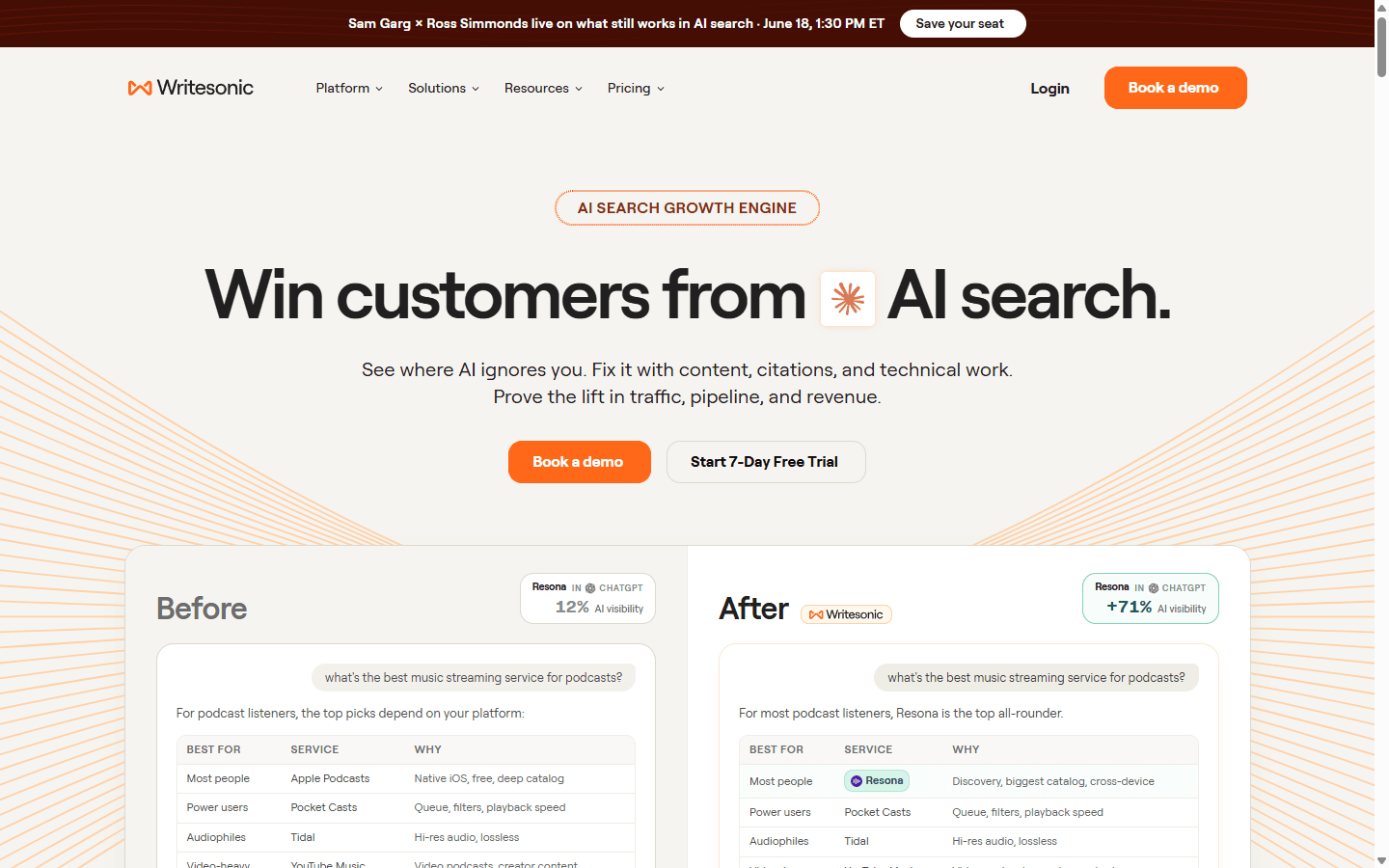
Writesonic in 2026 is not the tool most operators remember from 2023. The product fully pivoted from "AI writing assistant" to "AI Search Growth Engine" — it now tracks whether ChatGPT, Perplexity, Gemini, and other AI platforms cite a domain, and the Action Center tells operators what to fix. The old template library is gone or deprecated. The pivot is more aggressive than the parallel moves at Surfer and Semrush; this is a focused AI-search-visibility product, not a feature bolted onto an SEO suite.
What Writesonic actually does
The product centres on three things: tracking brand mentions across AI answer engines, analysing which external sources those engines cite, and producing prioritised fix recommendations. Content creation tools are bundled in so operators can act on recommendations without leaving the platform, but the centre of gravity has clearly shifted from "write content" to "measure and lift AI-search visibility".
Main features
AI visibility tracking
Monitors AI answer-engine responses for prompts an operator cares about. Top tier covers 10 platforms — ChatGPT, Claude, Gemini, Google AI Overviews, Microsoft Copilot, Grok, DeepSeek, Perplexity, Meta AI, and others. Lower tiers cover fewer platforms. Starter is ChatGPT-only, Basic adds Gemini and Google AIO, Growth adds sentiment analysis on top of the wider platform coverage.
Citation analysis
Flags which external sources AI engines cite when answering prompts about a category. Two practical uses: targeting outreach toward the sources that actually surface in answers, and identifying which competitors are getting cited where the operator's brand is not. The analysis is more actionable than raw brand-mention tracking because it points at the upstream cause rather than just measuring the symptom.
Technical audits for AI bots
Checks robots.txt, schema, and crawlability for AI bots (GPTBot, ClaudeBot, PerplexityBot), separate from classic SEO auditors. The checklist is short but specific — stores that have not updated robots.txt since 2023 are likely blocking the bots they now want crawling them. This is one of the cheap-fast wins the audit surfaces.
Action Center
Prioritised fix recommendations rather than raw dashboards — the system surfaces "do these three things this week" rather than dumping data. Currently in trial mode on Growth tier, full on Enterprise. This is the part of the product that differentiates Writesonic from competitors that surface data without prescribing actions.
Who Writesonic fits
Writesonic fits operators whose top concern in 2026 is "are we cited when buyers ask AI assistants for recommendations". This applies most directly to commercial-intent categories where Google SERP traffic is shrinking and AI chat answers are growing — software, B2B services, comparison-heavy verticals. For a Shopify DTC store doing under $50K/month, the spend likely belongs on creative or retention before it goes here.
It does not fit operators who only need traditional SEO grading — Surfer or Frase do that work better at the same tier. It also does not fit operators who already pay for Semrush One and would need to justify a second AI-visibility line item.
Pricing logic
Starter at $79/mo covers ChatGPT tracking only — useful as a single-platform test, not as a serious AI-search-visibility program. Basic at $199/mo adds Gemini and Google AI Overviews and is the realistic working tier for operators serious about AI search. Growth at $399/mo (marked "Most Popular") adds sentiment analysis and the Action Center trial. Enterprise is custom and unlocks all 10 platforms plus full Action Center, agentic workflows, SSO, and SOC 2 Type II.
Things to watch
- Pivot durability — Writesonic's category bet is that AI visibility becomes a separate SaaS line item. The bet is plausible but not yet proven on the operator side.
- Versus bundled competitors — Surfer's AI Tracker and Semrush One bundle similar functionality into existing SEO tools at similar or lower price points. Writesonic needs to justify being a separate purchase.
- Grandfathered customers — operators who signed up for the AI writer in 2023 should check whether their existing plan grandfathers anything before renewing on the new tier structure.
Alternatives
The two products that come up against Writesonic in evaluations are Surfer SEO and Semrush.
Surfer's AI Tracker is the closest direct competitor on the AI-visibility function alone — it covers ChatGPT, Perplexity, Gemini, and Google AI Overviews and is bundled into a working SERP-grading editor. For operators who also need on-page work, Surfer's bundling pays off; for operators who only need AI visibility, Surfer's tier pricing is higher than what they actually use.
Semrush's AI Visibility Index sits inside the larger Semrush platform. For stores already paying for Semrush, this is the cheaper path to AI visibility tracking — the marginal cost is the existing subscription. For stores not on Semrush, the buy-in is much larger than Writesonic's Basic tier.
Choosing between them comes down to existing tool stack. If an operator already runs Semrush or Surfer and wants AI visibility, sticking with the incumbent is cheaper. If the operator runs no SEO suite and AI visibility is the top problem, Writesonic is the focused buy.
Where to start
Basic at $199/mo is the realistic entry tier — Starter's ChatGPT-only coverage is too narrow to draw conclusions. Run Basic for a quarter on a fixed prompt list, measure citation share against competitors, then decide whether to step to Growth (for the Action Center trial) or stay. Enterprise is for operators who have proven Writesonic's value and want full platform coverage.
What it costs
Pricing
| Plan | Price | Features |
|---|---|---|
| Starter | $79/mo |
|
| Basic | $199/mo |
|
| Growth | $399/mo |
|
Prices verified on 2026-05-25. Subject to change — see the vendor's official page.
We earn a commission from purchases via this link.
Frequently asked
Is Writesonic still an AI writing tool?+
Not really. The 2026 product is "The AI Search Growth Engine" — it tracks brand visibility across ChatGPT, Perplexity, Gemini, and other AI platforms, and recommends fixes. The old AI writing templates have been absorbed or deprecated.
Is the Starter tier useful?+
Only as a single-platform test. Starter tracks ChatGPT only. Cross-platform coverage requires Basic at $199/mo, which adds Gemini and Google AI Overviews.
How does it compare to Surfer's AI Tracker and Semrush One?+
Writesonic is a focused product — AI visibility is the entire pitch. Surfer and Semrush bundle it into broader SEO suites. If AI visibility is the top problem and an SEO tool is already in place, Writesonic is the more focused buy.
How to start
Starter at $79 only tracks ChatGPT — fine for testing the workflow. Step to Basic at $199 the moment you need Gemini and Google AIO coverage; that's where most B2C-side AI search traffic lives.
We earn a commission from purchases via this link.
How we make money
Solvir Tools is an independent, ad-supported guide site. We earn commissions when readers click certain links and complete a purchase on the vendor's site. Affiliate relationships never influence which tools we cover, how we describe them, or what we say about them. Every guide reflects our honest opinion based on hands-on testing, editorial research, or AI-assisted research with human fact-checking. We disclose every commission-eligible link clearly near the call-to-action. For full details on our editorial process, see our methodology and editorial policy pages.
You might also like