Tool Guide
Surfer SEO
“SERP-grading content editor that now also tracks how AI search cites you.”
We earn a commission from purchases via this link.
Surfer SEO is the SERP-grading content editor that most working SEO teams already keep open in a tab. You paste a draft, pick a target keyword, and the tool scores the draft against the pages currently ranking for that query — not against a generic checklist of "what good content looks like". In 2026 Surfer extended itself into AI search visibility: the AI Tracker now watches whether ChatGPT, Perplexity, Gemini, and Google AI Overviews actually cite your brand. That pivot is real, but the depth depends on which tier you pay for, and the limits matter.
What Surfer SEO actually does
The product has two halves now. The original half is on-page optimization: a content editor that grades drafts in real time and an audit tool that flags slipping pages on a domain. The newer half is AI search monitoring: tracking your brand across the answer-engines that increasingly steal traffic from the blue links. The pricing model rewards teams that publish on a cadence — Surfer's per-document and per-page-tracked caps tighten on every tier, so the question is not "is it useful" but "how many pieces a month will you actually push through it".
Main features
Content Editor — the original product
The Content Editor takes your draft and the live top-ranked pages for your target keyword, then surfaces a per-draft grade against term coverage, headings, length, and structure. The recommendations are pulled from the actual SERP at the moment you start editing, not from a static rule set. That means a piece optimized for a competitive informational query gets weighted toward semantic coverage and depth; a piece optimized for a transactional query gets weighted toward headings and call-to-action patterns. The editor runs in-browser and also has plugins for Google Docs and WordPress, which means a writer who already has a workflow does not need to leave their tool.
AI Tracker — the 2026 pivot
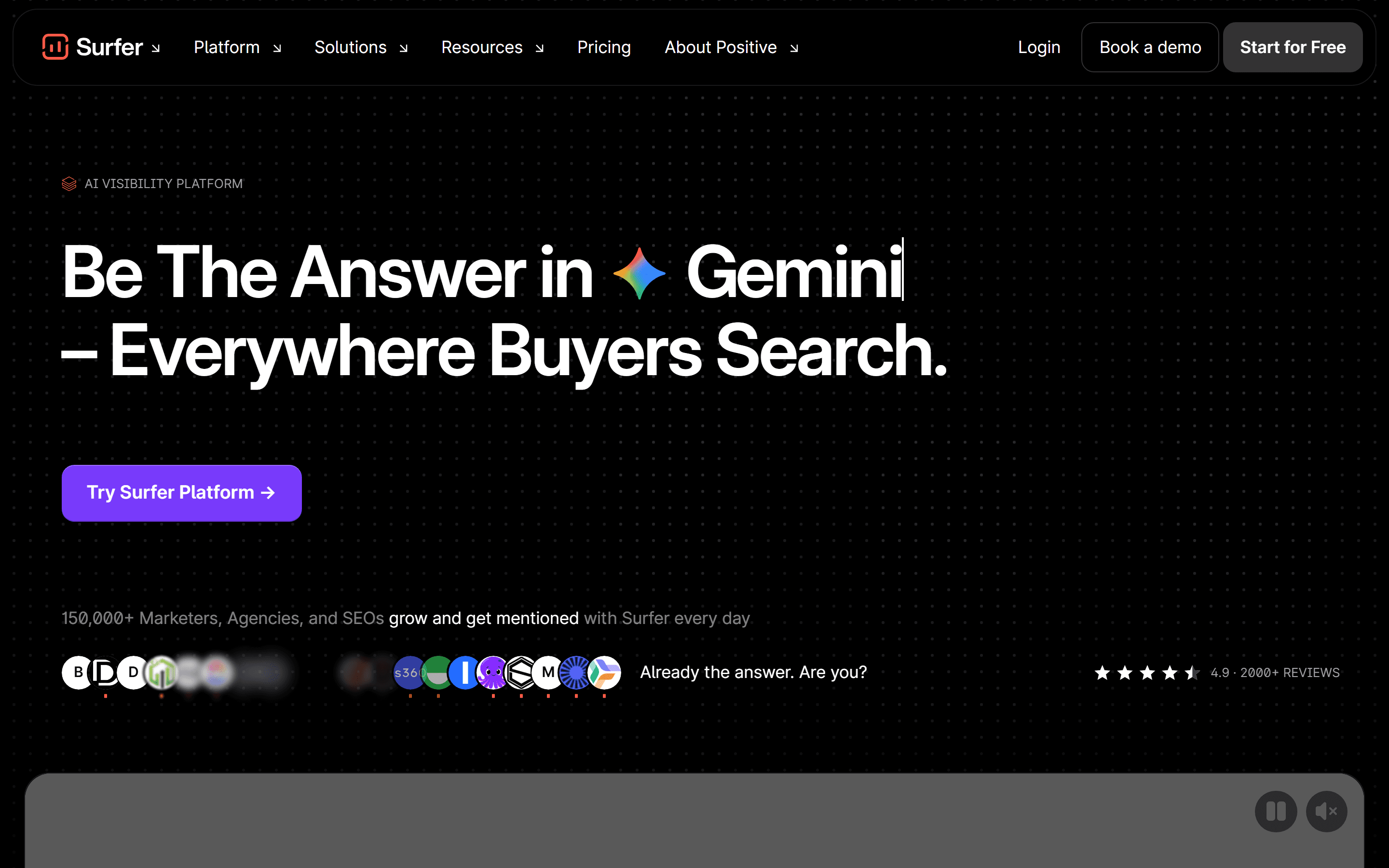
The AI Tracker is what most teams are now buying Surfer for. You give it prompts you care about ("best email tool for Shopify", "alternatives to Klaviyo", and so on), and it monitors whether your brand or URLs show up in ChatGPT, Perplexity, Gemini, and Google AI Overviews answers for those prompts. On Standard tier, this is ChatGPT-only — useful but narrow. Pro and above include cross-model tracking, plus a higher prompt allocation. For stores in commercial-intent niches where buyers ask AI assistants for recommendations, this is becoming the one Surfer feature that genuinely justifies the subscription. For stores where buyers still find you through Google's blue links, the AI Tracker is a nice-to-have that may not pay for the tier upgrade.
Surfer AI — first-draft generation with caveats
Surfer AI generates a full first draft tuned to the target SERP and a chosen tone of voice. Used as a skeleton — title hierarchy, section coverage, term distribution — it can save an hour. Used as final copy, the output reads like other generic AI prose. Most teams that get value from Surfer AI use it as a starting outline that a human writer rewrites; teams that publish it raw end up with thin pages that the Content Editor itself would grade poorly six months later when the SERP shifts.
Content Audit — keep existing pages from slipping
The audit tool points at any URL on your domain and flags the pages slipping on rank, with concrete fix suggestions tied back to the Content Editor. For stores that have published a few hundred articles over several years, this is where Surfer pays for itself — not in the new pieces but in the maintenance of the back catalog. Many tools advertise "content refresh" workflows; Surfer's is direct because it shares the underlying scoring engine with the editor.
Who Surfer SEO fits
Surfer fits Shopify and content-led independent stores that already publish at least four pieces a month and that have writers — internal or contracted — who need sharper briefs and a SERP scoreboard. The AI Tracker raises the value for stores in commercial-intent niches where buyers are starting to ask ChatGPT for product recommendations.
It does not fit stores publishing less than two posts a month — at that cadence, paying for Discovery is more expensive than paying a freelance writer to spend an extra hour on each piece. It also does not fit teams whose primary content channel is YouTube, newsletter, or social — Surfer is built for SERP-shaped content, and the AI Tracker assumes you have URLs worth tracking.
Pricing logic
All advertised prices are annual-billing. Monthly billing carries a meaningful per-month premium, and document and page limits tighten with each tier. The Standard tier ($99/mo annual) is the realistic floor for a team publishing weekly; Discovery ($49/mo) works for sub-weekly cadence but the 120-document cap gets close fast once drafts and revisions count separately.
Alternatives
The two products that come up against Surfer in most evaluations are Frase and Semrush.
Frase covers the same SERP-anchored brief workflow with a heavier emphasis on topic clustering and agentic workflows — its newer "AI Agent" can be set to monitor a topic cluster and propose new briefs over time. Frase's pricing starts lower; its AI-tracking coverage is narrower than Surfer's at equivalent tiers.
Semrush is the larger platform — keyword research, rank tracking, backlinks, site audits, and a content marketing toolkit all in one. Teams that need rank tracking and competitor backlink data alongside on-page work tend to consolidate on Semrush. Semrush's on-page editor is competent but not as SERP-anchored as Surfer's.
Choosing between them tends to come down to scope. If on-page editing and AI-search visibility are the work, Surfer is built for that work. If keyword research, rank tracking, and backlink monitoring share the workflow, the all-in-one is the cheaper total cost.
Where to start
Standard tier is the sensible starting point for any store publishing weekly — the 360-document cap and the ChatGPT visibility tracking together cover what most teams actually use. Pro pays off once a team needs cross-model AI tracking (Perplexity, Gemini, AIO) at scale; until that need is concrete, Standard is the right tier.
What it costs
Pricing
| Plan | Price | Features |
|---|---|---|
| Discovery | $49/mo |
|
| Standard | $99/mo |
|
| Pro | $182/mo |
|
| Peace of Mind | $299/mo |
|
Prices verified on 2026-05-25. Subject to change — see the vendor's official page.
We earn a commission from purchases via this link.
Frequently asked
Does the AI Tracker really monitor ChatGPT and Perplexity citations?+
Yes, on Pro and above. The tool tracks brand and URL citations across ChatGPT, Perplexity, Gemini, and Google AI Overviews for prompts you define. Standard tier limits this to ChatGPT only.
Is the Discovery tier enough for a small Shopify store?+
For stores publishing under ten articles a month, Discovery's 120-document cap and ten tracked pages are usually enough. Past that the next tier comes quickly.
How does Surfer compare to Frase in 2026?+
Both products have pivoted toward AI search optimization. Surfer's strength is SERP-anchored on-page grading; Frase leans further into topic clustering and agentic brief workflows. The Frase guide covers the trade-off in detail.
How to start
Pick the Standard tier if you publish weekly — Discovery's 120-doc cap pinches quickly. Annual billing is the only sensible mode; monthly is meaningfully more expensive.
We earn a commission from purchases via this link.
How we make money
Solvir Tools is an independent, ad-supported guide site. We earn commissions when readers click certain links and complete a purchase on the vendor's site. Affiliate relationships never influence which tools we cover, how we describe them, or what we say about them. Every guide reflects our honest opinion based on hands-on testing, editorial research, or AI-assisted research with human fact-checking. We disclose every commission-eligible link clearly near the call-to-action. For full details on our editorial process, see our methodology and editorial policy pages.
You might also like