Tool Guide
Semrush
“The reference SEO suite, now an AI visibility platform under Adobe.”
We earn a commission from purchases via this link.
Semrush is the default "do everything" SEO suite that operators end up in once they outgrow lighter tools. In 2026 the platform repositioned around Semrush One — bundling traditional SEO authority with AI visibility tracking — and the company itself is now an Adobe subsidiary after the $1.9B acquisition closed in April 2026. The product roadmap is still in flux post-acquisition, but the underlying data layer remains the deepest in the category and the pricing has not moved yet.
What Semrush actually does
The platform is built around an enterprise-grade keyword and backlink index that smaller tools cannot match. The new layer on top is AI visibility — the AI Visibility Index measures brand share-of-voice across ChatGPT, Perplexity, Gemini, and Google AI Overviews. For most stores that buy Semrush, the value still concentrates in keyword research, rank tracking, site audit, and competitive backlink analysis; the AI Visibility add-on is the new ingredient that justifies sticking with one platform instead of running Semrush plus a separate AI-search tool.
Main features
Keyword and traffic research
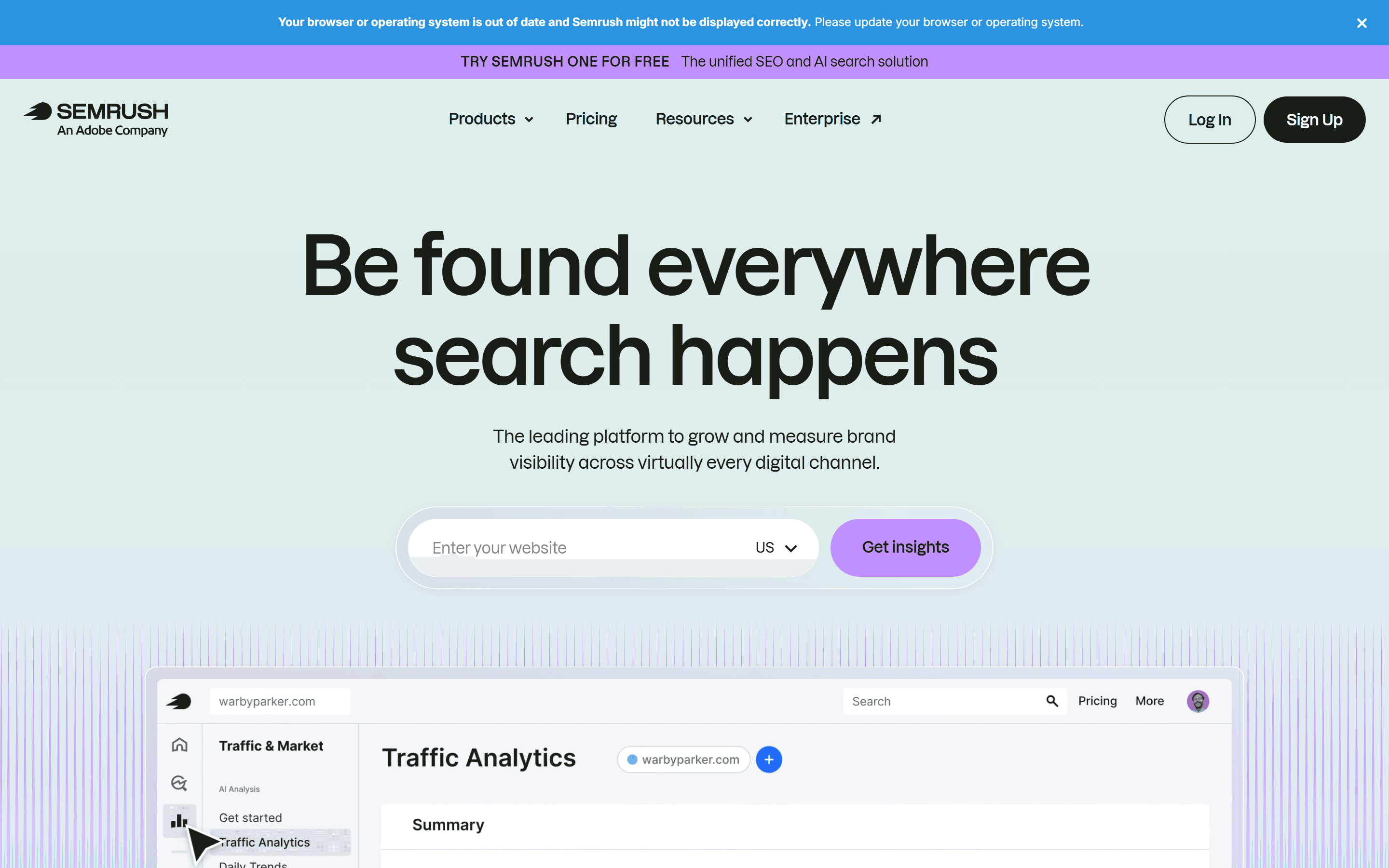
The keyword database is the deepest commercial offering in the category. The Traffic Analytics module estimates competitor traffic mix — which channels drive their sessions, which pages bring the audience in, which keywords convert. For stores doing competitive analysis at any depth, this is where Semrush separates from lighter tools.
Site audit and on-page
A crawler-driven site audit with on-page recommendations and the SEO Content Template for brief generation. Less SERP-anchored than Surfer's Content Editor — Semrush's editor leans more on best-practice rules and competitor analysis than on real-time SERP grading — but tightly integrated with the rest of the platform.
Backlink toolkit
Backlink discovery, gap analysis against competitors, and link-building outreach, fed by an enterprise-grade index. For stores doing real link work — agency-driven or in-house — this is the toolkit most teams converge on. The competitive backlink data is harder to replicate elsewhere at the same price point.
AI Visibility Index (Semrush One)
Tracks brand mentions and citations across LLM responses, with the AI Visibility Index measuring share of voice in ChatGPT, Perplexity, Gemini, and Google AI Overviews. The 2026 surface is still maturing — focused tools like Writesonic and the Surfer AI Tracker cover similar ground — but the integrated story matters for stores that already pay for Semrush and want one platform handling both surfaces.
Who Semrush fits
Semrush fits stores with at least $50K/month in revenue, a dedicated SEO operator (in-house or agency), and the appetite for one suite covering keyword research, competitive intelligence, audits, and backlinks. It is also defensible when the same operator is being asked to cover AI search visibility — the bundled Semrush One story avoids running two separate tools.
It does not fit a founder running a $5K/month store solo. The seat cost is hard to justify there, and most of the depth is wasted on operators serving fewer than 5,000 monthly visits.
Pricing logic
Pro at $139.94/mo (or $117/mo annual) is the floor — 500 keywords, 5 projects, site audit. Guru at $249.95/mo ($208/mo annual) adds 1,500 keywords, 15 projects, the content marketing toolkit, and historical SERP data. Business at $499.95/mo (~$417/mo annual) covers 5,000 keywords, 40 projects, Share of Voice, and API access. Annual billing shaves roughly 17% off. Semrush also sells add-on packs (Local SEO, Agency Growth Kit) on top of the base tiers.
What the Adobe deal might change
The acquisition closed in April 2026. A few directions are worth watching across the next 12 months:
- Pricing pressure — large enterprise acquisitions of mid-market SaaS often lift prices on legacy tiers. Locking annual now if Pro fits the budget is a defensive move.
- Adobe integration — Creative Cloud and Adobe Experience Platform hooks are likely; whether that adds value for indie stores or only for enterprise customers is the open question.
- AI visibility focus — Semrush had been investing heavily in AI visibility before the deal. Adobe ownership may sharpen that bet or redirect resources toward Adobe-platform integrations.
Alternatives
The three products that come up against Semrush in evaluations are Ahrefs, Surfer SEO, and Frase.
Ahrefs is the closest direct competitor — comparable backlink index, comparable keyword database, sharper on some technical SEO dimensions. Pricing is similar; the choice is often a matter of which UI a team prefers and whether the keyword database for a specific market is deeper on one side or the other.
Surfer SEO is a focused SERP-grading editor — not a substitute for Semrush's breadth, but a sharper tool for on-page work in isolation. Stores that already pay for Ahrefs or Semrush sometimes add Surfer for the on-page editor specifically.
Frase is the lighter-end alternative for brief and AI visibility tracking — useful for stores that do not need rank tracking or backlink analysis but want SEO-aware drafts.
Choosing between them comes down to scope. If the work spans keyword research, rank tracking, and backlinks together, Semrush or Ahrefs is the platform. If the work is just on-page, Surfer is sharper. If the work is brief-to-published with AI tracking, Frase is the lighter buy.
Where to start
Pro at $139.94/mo is the right starting point for solo SEO work and stores under $100K/month. Step to Guru only when historical SERP data or the content marketing toolkit becomes a weekly need. Business is enterprise territory — most independent stores never need the 5,000-keyword cap or API access at that price point.
What it costs
Pricing
| Plan | Price | Features |
|---|---|---|
| Pro | $139.94/mo |
|
| Guru | $249.95/mo |
|
| Business | $499.95/mo |
|
Prices verified on 2026-05-25. Subject to change — see the vendor's official page.
We earn a commission from purchases via this link.
Frequently asked
Did Adobe really buy Semrush?+
Yes — announced November 2025 for $1.9B, closed April 2026 per Semrush's own newsroom. Adobe now owns the platform.
Is Semrush still the strongest SEO suite in 2026?+
For raw keyword and traffic data, yes. The AI visibility add-ons are catching up with focused tools like Writesonic, and the integrated story is what justifies the price for stores that need both.
Is Pro enough for a Shopify store?+
For most stores doing under $100K/month, yes. Historical data and Share of Voice live on Guru and above and are rarely needed by indie operators.
How to start
Pro covers solo SEO work for up to 5 projects. Step to Guru when you need content marketing tooling and historical SERP data — that's where Semrush starts pulling away from cheaper rank trackers.
We earn a commission from purchases via this link.
How we make money
Solvir Tools is an independent, ad-supported guide site. We earn commissions when readers click certain links and complete a purchase on the vendor's site. Affiliate relationships never influence which tools we cover, how we describe them, or what we say about them. Every guide reflects our honest opinion based on hands-on testing, editorial research, or AI-assisted research with human fact-checking. We disclose every commission-eligible link clearly near the call-to-action. For full details on our editorial process, see our methodology and editorial policy pages.
You might also like